Uncategorized
How to Modernize Your CRM with AI: A Practical Guide
In the next three years, a CRM without embedded AI is going to be outdated and actively work against you. Big Consulting has spent decades selling bloated, endless projects that trap your data in static filing cabinets and charge you by the hour to do it. It’s time to update your system so it actually works for you.
You know the drill. The data is in there somewhere. The dashboards technically function. Yet your reps avoid the system entirely, and leaders don’t trust the forecast. The CRM has become a place where information goes to sit. If this hits close to home, the fix is a deliberate choice to modernize CRM with AI. We have to turn a passive system of record into a revenue engine.
This is a fundamental CRM transformation. This guide walks through what CRM modernization really means, why it matters right now, how AI is reshaping the modern CRM, and a practical, step-by-step approach to getting there without the usual overwhelm. By the end, you’ll know exactly where to start and how to measure the return.
What It Means to Modernize a CRM with AI
CRM modernization is the process of upgrading your platform so it actually interprets data, recommends actions, and does the heavy lifting nobody wants to do by hand. When you modernize CRM, you layer predictive insights, generative content, and active digital workers over your existing data. The system starts contributing to your outcomes instead of just recording them.
Let’s draw a hard line here: buying a brand-new platform is a replacement; making the platform you already own intelligent, usable, and outcome-driven is modernization. For most mid-market and enterprise teams, creating an Intelligent CRM out of what you already have delivers a much faster return. You build on your existing processes instead of starting from zero.
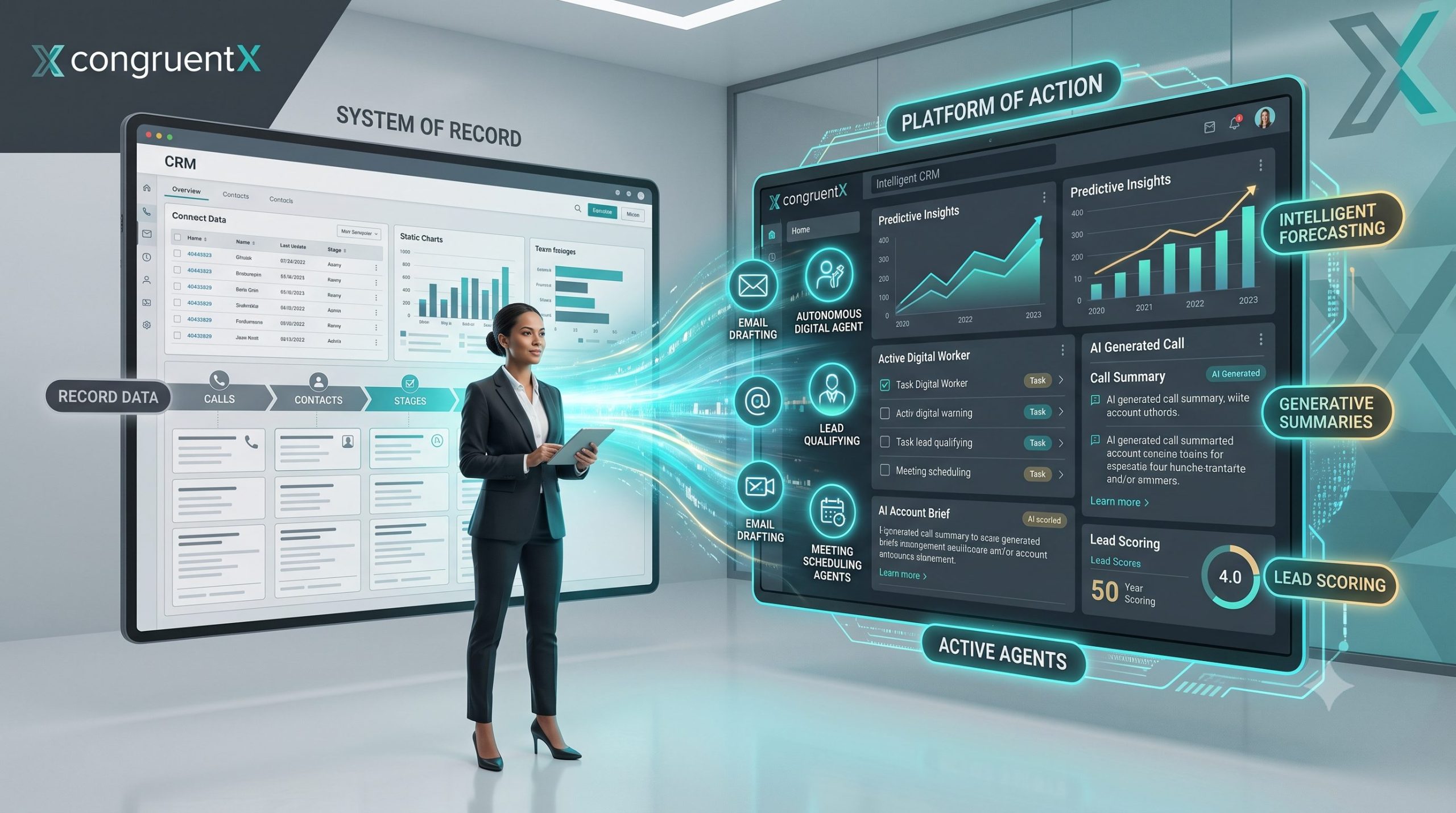
From a System of Record to a Platform of Action
Legacy CRMs were built to answer one simple question: what happened? They logged calls, stored contacts, and tracked deal stages. That was great in 2010. Today? It’s the bare minimum.
A modern, AI-enabled CRM answers a much better question: what should happen next? Instead of waiting for a rep to log a note, the system drafts the follow-up. Instead of generating a clunky report, it flags an at-risk account before the renewal slips. This shift from a system of record to a platform of action is the entire point of bringing AI into the picture.
Don’t want to wait to take action? If you’re ready to see exactly how deploying digital workers and active agents can eliminate friction and transform your CRM into a dynamic revenue engine, skip ahead and sign up for our Ai-Fueled Copilot Envisioning Lab to see firsthand how our human-led, AI-accelerated approach will dramatically improve your ROI.
Signs Your Legacy CRM Is Holding You Back
Systems rarely fail all at once. Usually, an outdated setup erodes performance in small, frustrating increments. Watch for these signals:
- Low adoption. Reps keep their real pipeline in spreadsheets because the CRM is too clunky to bother with.
- Distrust in the data. Leadership second-guesses the forecast. The underlying records are usually stale anyway.
- Manual everything. Data entry, task reminders, and report-building eat up hours that should be spent selling and serving.
- No foresight. The system tells you what already happened but never warns you about what’s coming.
- Tool sprawl. Critical context lives in email, chat, and disconnected apps instead of one trusted hub.
If these sound familiar, you have a system that needs to be modernized.
Why CRM Modernization Matters Now
The pressure to act right now isn’t about chasing the latest tech trend. It’s pure economics. Teams are constantly asked to do more with the same headcount. The gap between what we intend to do and what we actually have the capacity to do keeps widening.
Microsoft’s own research points directly at this squeeze: leaders want productivity to go up, but the workforce simply doesn’t have enough hours in the day. You can read more in Microsoft’s overview of AI-powered CRM solutions. AI closes that gap by taking over the repetitive, low-value work that no longer requires a human to monotonously perform, freeing your people up to do the true value-added work that contributes directly to the bottom line.
The Hidden Cost of an Outdated CRM
A legacy CRM doesn’t show up as a line item on your P&L, which is exactly why it’s so dangerous. The cost is hidden. It lives in slower deal cycles, ignored forecasts, missed customer issues, and highly paid professionals spending their Friday afternoons cleaning up data. Industry studies prove time and again that most CRM implementations miss their original goals simply because the software doesn’t match how humans actually work. Modernization is how we stop paying this invisible tax.
Key Benefits of AI in CRM
When you build an AI CRM strategy that treats intelligence as core infrastructure—not a bolt-on gimmick—the results compound across your entire revenue cycle. The core benefits of AI in CRM include:
- Time back for selling and serving. Automated note-taking, record updates, and summaries hand hours back to your team every week.
- Forecasts you can defend. Predictive scoring grounds your pipeline in actual buyer behavior, not just rep optimism.
- Cleaner data, automatically. AI flags duplicates, fills gaps, and validates records without requiring a massive manual cleanup project.
- Faster, more consistent service. Routine inquiries get resolved instantly, and complex cases route to the right person with the full context attached.
- Personalization at scale. Every customer interaction reflects their unique history without a human having to piece it all together by hand.
These aren’t just vendor promises. These are the practical payoffs of doing AI right.
How AI Is Transforming the Modern CRM
We need to get specific about how AI is transforming CRM, because “AI” is a big, vague word that covers a lot of ground. In reality, it breaks down into three distinct capabilities that actually matter for revenue teams.
Predictive Insights and Smarter Forecasting
Predictive AI looks at patterns across your historical and live data to point your team in the right direction. It scores leads based on their actual likelihood to convert. It flags accounts showing early churn signals. Most importantly, it forecasts revenue based on what’s actually moving in the pipeline, rather than what a rep hopes will close by the end of the quarter. You shift from reactive to proactive, saving a slipping deal before it’s gone, not after.
Generative AI for Content, Summaries, and Data Entry
Generative AI handles the tedious synthesis that quietly drains productivity. It drafts personalized emails, boils long call transcripts down to a few bullet points, and turns a messy string of interactions into a clean account brief. Even better, it slashes manual data entry by capturing information from emails and calls automatically. The records stay current, and nobody has to force them to.
AI Agents That Automate Non-Selling Work
This is where we cross into the Frontier. AI agents in CRM are autonomous digital workers that can take a task from start to finish. They qualify inbound leads, schedule meetings, draft case responses, and follow up on quotes. And they learn from each interaction instead of following a rigid, frustrating script. Unlike a basic chatbot, an agent operates inside your CRM, acting as a digital teammate. We detail exactly how this looks in our guide to AI Agents and Dynamics 365 Integration Use Cases. The goal is simple: agents take the non-selling work off the board so your people can focus on the work only humans can do.
How to Modernize Your CRM with AI: A Step-by-Step Approach
Knowing how to modernize CRM with AI means rejecting the massive, multi-year “transformation” project. Those almost always fail. Success comes from a sequence of focused moves, where each step delivers real value before the next one starts. Here is the framework we use.
Step 1 – Assess Your Current CRM and Data Readiness
Start with a brutally honest audit. Where is your team working around the system? Which fields are actually reliable, and which are a complete mess? AI is only as smart as the data it sits on. This step is non-negotiable. You have to identify the highest-friction workflows and clean up the hygiene issues before any model touches them.
Step 2 – Define Your AI CRM Strategy and Priority Use Cases
Do not try to sprinkle AI everywhere all at once. A real AI strategy maps specific use cases to tangible outcomes—revenue, retention, speed—and ranks them by impact. Pick one or two areas that combine a real business headache with clean enough data to fix it. This is where you decide what “better” actually looks like in numbers you can track.
Step 3 – Start with One High-Impact AI Agent
Prove the model with a single, sharply focused agent. Don’t go for a massive rollout. Lead qualification and case triage are fantastic starting points because the value is immediate and easy to prove. Getting one agent right builds internal trust, teaches you valuable lessons cheaply, and gives you a concrete win to expand on.
Step 4 – Embed Governance, Security, and User Adoption
This is a people project just as much as a technical one. You need to define access rules, escalation paths, and audit trails for every digital worker. Keep a human in the loop for sensitive decisions. Pair that governance with actual change management. The most capable AI on the planet won’t do a thing if your team refuses to log in.
Step 5 – Measure ROI and Iterate
Decide on day one how you’re going to judge success. Are you looking for hours saved? Faster response times? Better forecast accuracy? Pick the metrics, review them constantly, and refine. AI agents get better the more you use them, so your system should measurably improve over time. If you need a framework for tracking this, our breakdown on Maximizing ROI with AI Integration in Dynamics 365 explains exactly what to measure.
AI CRM Use Cases by Team
A modern setup looks completely different depending on who logs in. Here are the clearest wins across the core revenue functions.
Sales
- Predictive lead scoring that ranks prospects by real conversion likelihood
- Automated meeting scheduling and follow-up sequencing
- Next-best-action recommendations surfaced inside the deal record
- Auto-generated call summaries and account briefs
Customer Service
- Instant resolution of routine inquiries across chat, email, and voice
- Smart ticket routing with full context handed to the right rep
- Real-time sentiment analysis to flag at-risk interactions
- Knowledge articles that update automatically from resolved cases
Marketing
- Behavioral and demographic segmentation done in seconds
- Generative drafting of campaign content and personalized outreach
- Journey orchestration triggered by live customer signals
- Campaign performance insights that recommend the next move
Modernizing CRM with AI in Microsoft Dynamics 365
If your organization uses the Microsoft ecosystem, you already have a massive head start. Microsoft Dynamics 365 was built with AI woven deeply into the fabric, rather than bolted on as an afterthought. This removes a lot of the integration friction that completely stalls other platforms.
Copilot and AI Agents in Dynamics 365
Copilot is Microsoft’s built-in assistant across Dynamics 365 Sales, Customer Service, and beyond. It handles the busywork—drafting emails, summarizing records, and suggesting next steps in plain English. Beyond that, you can build custom digital workers with low-code tools in Copilot Studio. These agents manage follow-ups, qualify leads, and handle service tickets autonomously while staying strictly within your security boundaries.
Because it all lives on Dataverse and connects natively to Teams and Outlook, the CRM acts less like a static database and more like an active member of your team. We map out the exact implementation details in our guide to Integrating Copilot and AI Agents in Microsoft Dynamics 365.
How congruentX Helps You Modernize Without the Overwhelm
The reason most companies fail at modernizing legacy CRM systems isn’t the technologies fault. It’s the organization’s approach. Big Consulting loves to bill for endless hours while pushing all the delivery risk onto you. At congruentX, we reject that model entirely. We align your CRM, AI, and revenue tools to how your team actually works and we put our own fees on the line to guarantee the outcomes.
Every engagement puts at least one AI agent into production early, meaning you see real value in weeks, not years. Whether you’re upgrading an existing Dynamics 365 setup or migrating off a legacy or Salesforce platform, our goal is identical: deliver a CRM that earns its keep by driving measurable results.
The era of the passive database is over. If your CRM isn’t actively working to remove friction from your sales cycle, it’s holding you back. At congruentX, we don’t believe in implementing technology just for the sake of it. We don’t sell time; we deliver measurable outcomes. When you partner with us, you aren’t signing up for the effort trap of endless billable hours. Instead, we deploy digital workers and active agents seamlessly into your Microsoft ecosystem—ensuring your AI is built-in, not bolted-on. Our approach is entirely human-led and AI-accelerated, empowering your people to focus on high-value strategy while the system handles the execution.
What makes us a standout partner is our absolute accountability. We operate on a model of shared risk, meaning we hold our fees until we deliver the specific, verified business outcome we promised. We take on the delivery risk so you don’t have to.
Ready to turn your legacy system into a dynamic revenue engine?
Discover more about our outcome-obsessed approach at congruentX, or contact us today to discuss your specific goals. To see these AI agents in action, we invite you to sign up for an upcoming session or view past recordings on our Events & Webinars page.
Frequently Asked Questions
What is CRM modernization?
CRM modernization is the process of upgrading your customer relationship management system so it actively contributes to outcomes—through AI-driven insights, automation, and better usability—rather than simply storing data. It often means making the platform you already own intelligent and adoptable instead of ripping it out and starting over.
How does AI improve a CRM?
AI improves a CRM by embedding digital workers and active agents directly into your workflows to eliminate friction. Instead of relying on manual data entry or outdated reporting, this approach is human-led and AI-accelerated—automating routine execution so your people are empowered to focus entirely on high-value strategy. By predicting what should happen next and taking action autonomously, AI ensures your technology is actively working for you, rather than the other way around. Ready to explore how we can deploy these capabilities to drive measurable outcomes for your specific business? Contact us today to start the conversation.
How do I start modernizing my CRM with AI?
The traditional consulting model is broken, trapping businesses in bloated projects that prioritize billable hours over actual value. To start modernizing, you must reject the effort trap and focus entirely on accountability and shared risk. We don’t sell time; we deliver verified results by mapping specific AI agents to your most pressing business needs. We begin by proving the model with a single, high-impact use case, ensuring your intelligence is built-in, not bolted-on.
Next Steps
CRM modernization doesn’t have to be a multi-year, boil-the-ocean nightmare. It starts with one honest assessment and one highly focused win. If you’re ready to see what that actually looks like for your revenue teams, the congruentX Envisioning Lab maps out a practical, prioritized path in just a single working session. Stop managing your data, and start driving outcomes.