Insights
AI Consulting Firm Comparison: What Buyers Get Wrong
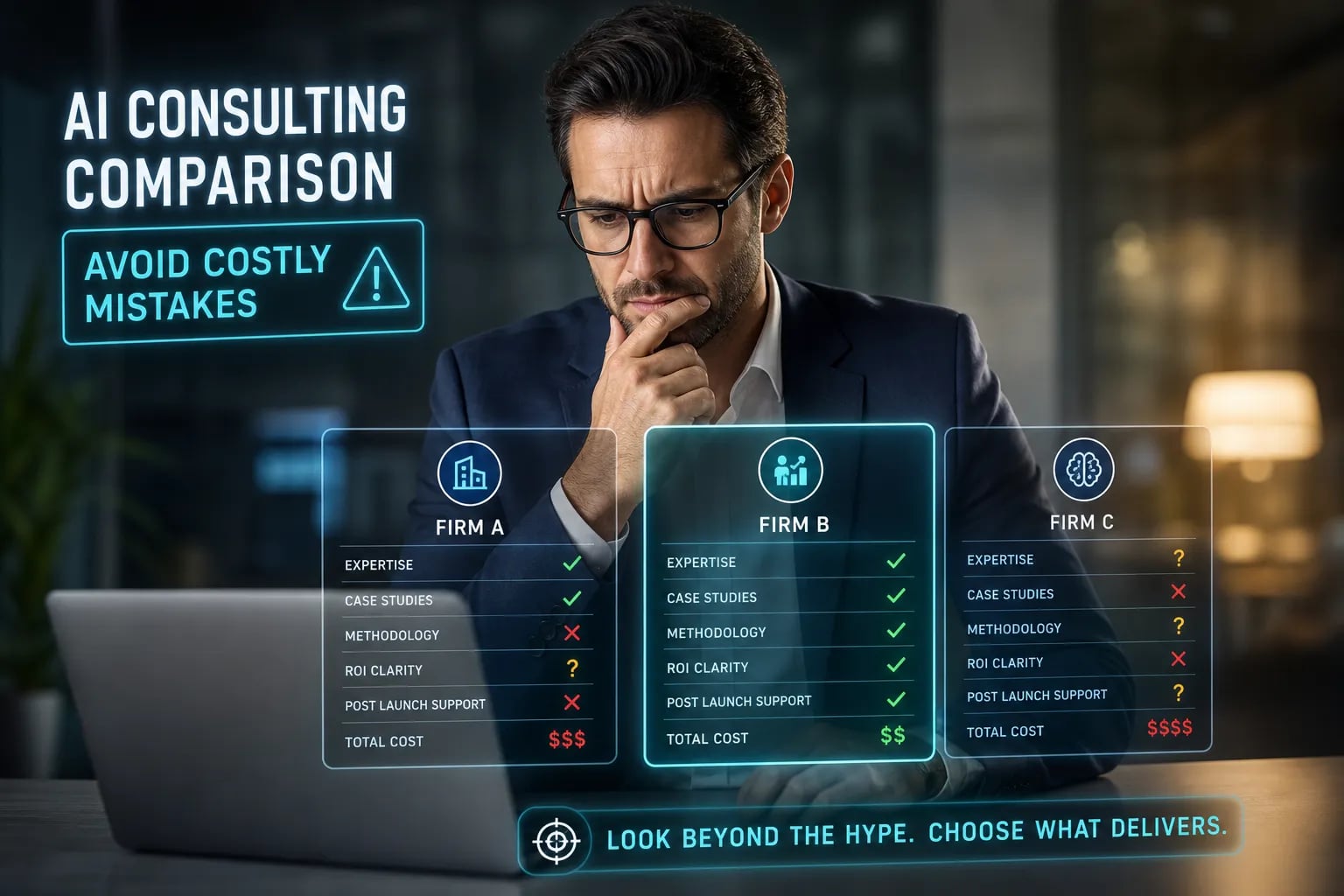
Many buyers conducting an AI consulting firm comparison spend weeks reviewing methodology slides, logo walls, and capability decks. Those things feel thorough. They’re not. None of them reliably predict whether a firm will actually deliver results inside your environment.
What predicts delivery success is simpler: how the firm structures financial accountability, and whether they’ve shipped AI into production environments, not just run pilots. Enterprise AI consulting engagements range from $25,000 discovery sprints to $2M+ transformation programs. The gap between firms that deliver and firms that invoice is enormous, and it’s almost never visible in a capabilities presentation.
A small number of AI consulting companies operate on fundamentally different terms than the rest of the market. Firms structured like congruentX (cX), which ties a significant portion of its fees to verified client outcomes, are telling you something through their pricing model alone. Below is a five-criteria scoring framework, a vendor question set, and a shortlisting process you can use before your next RFP goes out.
Why most AI consulting firm comparisons miss the point
Many buyers start by comparing credentials, team size, and client name drops. A firm with 10,000 consultants and a Fortune 500 logo wall can still fail your deployment if their incentive structure doesn’t require them to succeed. The real question is structural: what happens to the firm financially if the project doesn’t produce results? That question almost never appears on a vendor scorecard.
Traditional AI consulting services bill by the hour or milestone deliverable. That model transfers all delivery risk to the client. The firm gets paid whether or not the AI system reaches production. Research from MIT and Gartner estimates that 80% to 95% of enterprise AI projects fail to deliver measurable business value, and roughly half never reach production at all. Those numbers aren’t a technology problem. They’re an incentive problem. When nobody on the vendor side has skin in the game, the outcome is predictable.
Five criteria for a sharper AI consulting firm comparison
1. Capability and industry fit
Generic AI expertise doesn’t translate to domain-specific delivery. A firm with deep experience in wholesale distribution or industrial manufacturing will move faster and make fewer costly assumptions than a generalist shop with a broad portfolio. Ask for case studies from your exact sector, not adjacent ones. If a firm can’t speak your business language before the technical conversation starts, that’s a signal.
2. Delivery model and team composition
Large systems integrators run pyramid-staffed programs: senior partners scope the work, junior consultants deliver it. Boutique firms tend to operate with smaller, senior-dense teams where the people who scope the work also deliver it. Neither model is inherently superior, but the model directly affects accountability. Before signing anything, find out exactly who will be working your account after the contract is executed, not who presented in the sales meeting.
3. Pricing structure and financial accountability
This is the most honest signal any firm sends. Hourly billing, roughly $150 to $600 per hour for senior consultants, higher for MBB-tier partners, based on 2026 market benchmarks, or fixed-fee scopes with vague deliverable definitions shift all risk to you. Outcome-based pricing, where a portion of the firm’s fee is held until a verified business result is achieved, changes behavior throughout delivery. Ask every firm the same question: what percentage of your fee is contingent on our results?
4. Production evidence versus prototype history
There’s a meaningful difference between a firm that has run pilots and a firm that has shipped AI systems into production with documented operational outcomes. Some machine learning consulting firms, such as Deployed Labs, have published production deployment metrics and ROI cases from live enterprise environments. Pressure-test every firm you evaluate to that same standard. Ask specifically: how many of your past engagements are live in production today, and what are the measurable results?
5. AI agent maturity
Firms that embed AI agents natively into existing systems from day one tend to drive stronger adoption than firms that treat AI as a post-go-live add-on. When users encounter AI agents inside tools they already use, adoption happens more naturally. When AI is a separate layer added after deployment, adoption commonly stalls. The timing of when AI becomes operational for end users is a direct proxy for the firm’s delivery philosophy.
Why the pricing model is the most honest signal
Most firms quote hourly rates or fixed-fee project scopes. Outcome-based pricing is structurally different. A firm billing by the hour has no financial incentive to compress timelines or accelerate adoption. A firm with fees at risk does. The alignment difference isn’t subtle. It changes what the firm prioritizes throughout every phase of delivery.
congruentX (cX) is a useful benchmark for what genuine outcome accountability looks like. The firm structures its fees so that a substantial portion is withheld until client outcomes are verified across a five-milestone delivery framework: Diagnose, Align, Onboard, Adopt, Achieve. That structure is designed to remove what congruentX calls the “Effort Trap”, the consulting industry pattern where firms get paid for activity regardless of whether that activity produces results. It’s a direct rejection of how most enterprise AI consulting engagements are priced, and it’s worth using as a reference point when you evaluate any other firm.
A proposal heavy on time-and-materials line items with vague deliverable definitions is a yellow flag. A proposal that ties fee release to confirmed business outcomes, with named milestones and measurable KPIs, is a green one. The proposal structure tells you exactly how confident a firm is in their own delivery.
What production evidence actually looks like
Demos lie. Production systems don’t. When evaluating AI implementation partners, verify capability across five specific areas:
- Data readiness: Can the firmassess and remediate your source data, or do they just assume it’s clean?
- MLOps: Can they deploy, monitor, and retrain models after launch, or does their engagement end at go-live?
- Governance: Do they deliver AI policies, audit artifacts, and risk controls as part of the engagement, not as a separate billable workstream?
- Model neutrality: Are they vendor-locked to one platform, or can they genuinely select the best fit for your use case?
- Security: How do they handle sensitive data, access control, and runtime threat protection in production environments?
The difference between firms that embed AI agents natively into CRM systems from the start and firms that treat AI as a post-go-live addition is significant. Native embedding, Sales Agents, Data Quality Agents, Dialogue Copilots, can drive adoption velocity from day one because users encounter AI inside tools they already use. Firms that treat AI as a separate layer typically see adoption slow after the pilot phase ends. When reviewing any AI vendor comparison, ask specifically: at what point in the engagement do AI agents become operational for end users?
The questions that expose delivery gaps fast
On pricing accountability, three questions separate firms that are confident in their delivery from firms that aren’t. First: what percentage of your fee is contingent on client outcomes? Second: what happens contractually if we don’t achieve the defined business results? Third: can you show us an engagement where your fee structure required you to course-correct mid-project? A firm that answers all three clearly is worth your time. A firm that deflects or redirects is telling you something important.
On delivery model and AI capability, ask about team composition at the account level, who specifically delivers, not who sells. Ask about deployment velocity: how long from signed contract to live AI in production? Ask about governance: what AI policies and audit artifacts do you deliver as part of the engagement scope, not as an add-on? These questions separate firms with repeatable delivery systems from firms that figure it out project by project.
On industry and platform fit, enterprise AI consultants who specialize in your sector will reference your specific workflows, not generic transformation patterns. Ask for two client references in your industry, not case study PDFs, actual references. If the firm hesitates or offers to send documents instead, that tells you exactly where their production evidence actually sits.
How to build your shortlist in three steps
Start by scoring every firm against the five criteria: capability and industry fit, delivery model, pricing structure, production evidence, and AI agent maturity. Score each firm zero to three on each dimension. Any firm that scores zero on pricing accountability or production evidence should come off the list regardless of brand recognition. A recognizable name with a billable-hours model and a portfolio of pilots is not a delivery partner, it’s a vendor that sells time.
Before committing to a full engagement, require a scoped assessment phase where the firm evaluates your data environment, identifies specific AI use cases, and delivers a measurable baseline. congruentX offers a pre-engagement cX AI Lab structured to demonstrate value before full fees are committed, a useful model to look for in any firm you’re evaluating. That kind of structured entry point reduces your risk and reveals delivery quality early, before you’re locked into a larger contract.
Treat every pilot as a production test, not a proof of concept. A pilot that never reaches production is a demo with extra steps. Require that any pilot engagement include a defined path to production, a named business outcome, and a fee structure that reflects the firm’s confidence in achieving it. If a firm won’t commit to those terms in the pilot phase, they won’t commit to them in the full engagement either.
The comparison most buyers run is the wrong one
Capability decks and client logos don’t tell you whether a firm will deliver. Pricing structure, production evidence, and financial accountability do. The firms that put their fees at risk are sending a clear signal: they believe they’ll succeed. The firms that bill by the hour regardless of outcome are sending a different one.
Use this AI consulting firm comparison framework, the five criteria, the question sets, the shortlisting process, as your standard before any engagement. Require a pre-engagement assessment before committing to any full transformation program. The AI consulting market has too many firms that sell time and too few that sell results. Know the difference before you sign anything.