Insights
congruentX vs. Traditional Consultants: Who Bears the Risk?
Why Risk Allocation Matters in Consulting
When evaluating congruentX vs. traditional consultants, the single most important question is not about platform expertise or hourly rates—it is about who absorbs the financial loss if your CRM project fails to deliver.
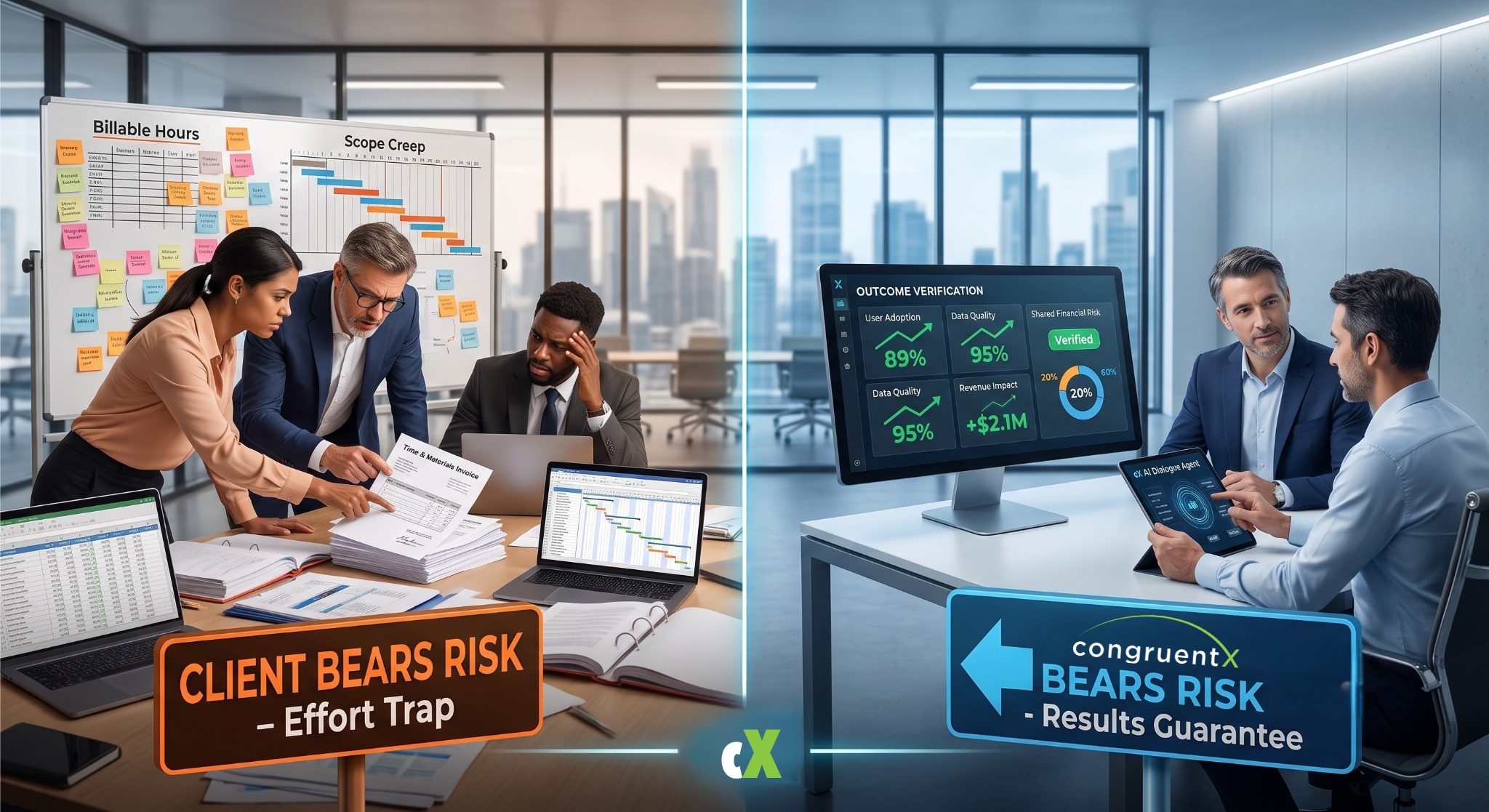
Most CRM consulting firms get paid whether your project succeeds or not. Their invoices go out on schedule. Your results may not. This is not an accident; it is exactly how the traditional consulting model is designed. Hours get billed, statements of work get signed, and the consulting firm’s financial health stays completely independent of whether your CRM ever generates a dollar of measurable return.
congruentX was built on the opposite premise: The Future of Outcomes. Instead of billing for time and materials, congruentX aligns its success directly with verified client business outcomes. That structural decision changes every choice made during a CRM engagement—how AI gets deployed, which resources stay engaged post-launch, and how executive accountability is maintained after implementation ends.
This article breaks down what separates this outcome-focused approach from conventional CRM consulting so you can ask better questions before signing your next engagement.
How Traditional CRM Consulting is Structured to Bill, Not Deliver
The Time-and-Materials Pricing Trap
The dominant pricing model in CRM consulting is time-and-materials (T&M) billing. Clients are charged by the hour, logging time paid regardless of whether the project is on track, behind schedule, or producing any tangible business value. Budget estimates at the start of an engagement are exactly that: estimates, not commitments.
Scope creep compounds this problem. In a T&M engagement, evolving requirements simply generate more billable hours. The consulting firm has no structural incentive to push back on expanding scope because more work equals more revenue. Buyers usually recognize this pattern only after the second or third change order, when the original budget is already a memory. This is not necessarily a character flaw in the consultants involved; it is the predictable output of how the engagement is financially structured from day one.
Risk and Accountability: Where Traditional Models Fall Short
The accountability gap sits at the end of the project, not during it. Traditional consulting contracts define success strictly as delivery: the system goes live, training sessions wrap up, documentation is handed over, and the final invoice is submitted.
What happens to user adoption rates, pipeline velocity, or revenue impact six months after go-live is rarely a contractual concern for a traditional firm. If the CRM sits unused while the sales team defaults back to spreadsheets, the firm has already been paid in full.
What It Actually Means to Focus on Outcomes
congruentX structures its engagements around outcomes, ensuring success is independently verified against pre-agreed business baselines rather than arbitrary project deadlines. Success isn’t defined by a go-live ceremony or a stack of handover documents—it is measured in actual, verified business results: user adoption, data quality scores, pipeline velocity, and revenue impact.
When an engagement is structured around shared outcome accountability, day-to-day delivery decisions shift in concrete ways:
-
Sustained Engagement: Senior resources stay engaged through ongoing adoption, not just through initial go-live.
-
Early AI Value: Intelligent agents and automation are deployed early to generate measurable impact quickly, rather than being pushed off as a “future phase” after the core system stabilizes.
-
Resource Prioritization: Work is prioritized around driving actual adoption and business performance, ensuring the client reaches maximum time-to-value.
AI Deployment Speed: When Agents Actually Show Up
In a conventional CRM engagement, AI is rarely part of the initial delivery scope. The platform gets deployed, users get trained, adoption is hoped for, and automation gets addressed in a later phase when budget allows. The sequencing is entirely linear: go live first, automate later. Months pass before any intelligent automation touches the workflows where it could actually change behavior. By the time the AI conversation resurfaces, organizational momentum has often stalled.
congruentX integrates AI and intelligent agents early in the engagement lifecycle. By leveraging modern AI tools and automated agents, working automation and clean data processes are brought directly into the CRM workflow to eliminate friction before user fatigue sets in.
Clean data and focused use cases consistently produce measurable ROI from AI agents in weeks, not quarters. congruentX builds that timeline into the engagement from the start rather than treating advanced automation as a bonus add-on down the road.
Client Risk Exposure: Who Absorbs the Cost When Outcomes Are Missed?
Industry estimates put the CRM implementation failure rate between 55% and 70% when measured against original ROI and adoption targets. The causes are overwhelmingly human and strategic: low user adoption accounts for nearly half of failures, followed by inadequate change management, poor data quality, and a lack of executive sponsorship. Technology problems account for only a small fraction of failures.
The pattern is consistent: the system gets delivered, users do not follow, and the client absorbs 100% of the financial loss while the consulting firm moves on to the next engagement.
When a CRM project misses adoption targets under a traditional model, the client carries sunk consulting fees, lost productivity, and the cost of attempting recovery. The consulting firm carries nothing because it was paid for effort, not outcomes. This is the Effort Trap: the firm sold time, the client bought results, and those were never the same product.
congruentX’s outcome-driven model restructures that exposure, establishing clear performance expectations and focusing on driving measurable adoption metrics from day one. When a consulting partner’s success is directly tied to client performance, the incentive to deliver genuine, long-term adoption is built into the partnership.
Who You’re Actually Hiring When You Sign a Consulting Contract
The comparison between congruentX and traditional CRM consultants ultimately comes down to one question: Where does the risk live?
-
In the traditional model, the client carries nearly all the risk. The consultant defines success as system delivery, gets paid on schedule, and moves on.
-
In the congruentX model, success is tied to your business outcomes. That structural difference changes how the engagement gets managed, resourced, and prioritized from week one through go-live and beyond.
Choosing between congruentX and traditional CRM consultants is not simply a vendor decision—it is a risk allocation decision.
Before signing any CRM consulting engagement, ask the firm one direct question:
“What does your company lose if we do not hit our adoption and ROI targets?”
If the answer is nothing, that tells you precisely how the engagement will be managed and who will be left holding the cost when things go sideways.
To explore how an outcome-based strategy applies to your specific environment, visit www.congruentX.com to learn more about our approach and start aligning your CRM strategy with real business results.