
Insights
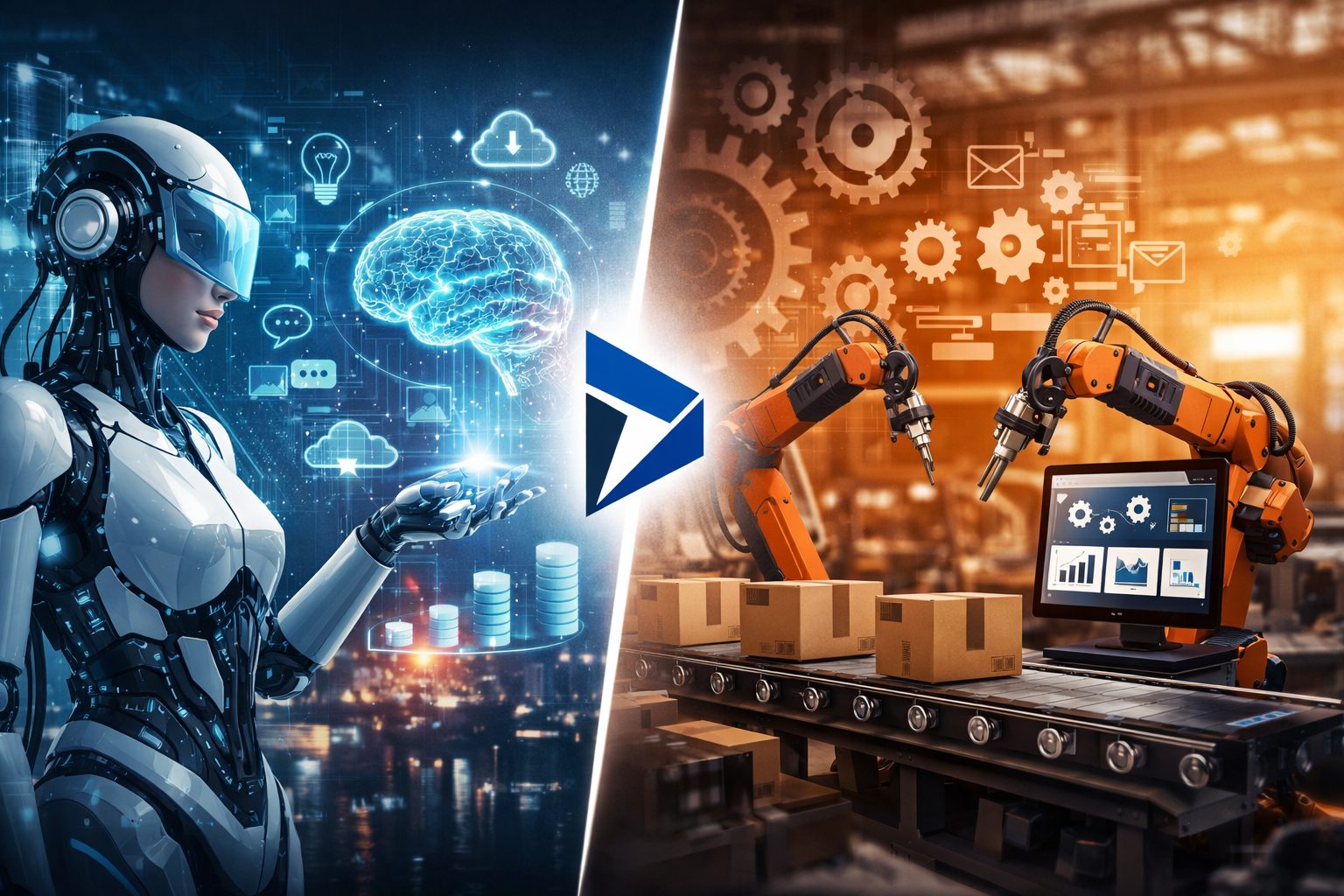
AI Agents vs Traditional Automation in Dynamics 365: What’s the Difference?
If you are weary of technology investments that promise autonomy but deliver a labyrinth of maintenance and manual oversight, you are not alone.
It’s a common frustration: “automated” systems that are so rigid they require constant human intervention just to keep running. It is time to stop serving your technology and demand that your technology starts serving you.
Businesses today are under constant pressure to improve efficiency, reduce costs, and deliver superior customer experiences. Automation has been a key driver of this transformation for years. However, with the rise of artificial intelligence, a new paradigm has emerged: AI Agents.
Within platforms like Microsoft Dynamics 365, organizations now face an important question: should they rely on traditional automation or embrace AI-powered agents?
If you are already wrestling with this decision and want to visualize the impact on your specific business, you don’t have to guess. Sign up for our Envisioning Lab to see exactly how we can help you improve your ROI and drive meaningful change.
This SEO-friendly guide explores AI Agents vs Traditional Automation in Dynamics 365, explains their differences, use cases, benefits, and limitations, and helps you decide which approach best fits your business needs and will hopefully help you get your technology to serve you.
Understanding Automation in Dynamics 365
Dynamics 365 has long supported automation to streamline CRM and ERP processes (such as sales workflows, customer service routing, finance approvals, and supply chain operations). Traditionally, this automation relied on rule-based logic.
Today, Dynamics 365 is evolving with AI Agents that can reason, learn, and act autonomously. Understanding the distinction between these two approaches is essential for modern enterprises.
What Is Traditional Automation?
Traditional automation refers to predefined, rule-based workflows that execute specific actions when certain conditions are met.
Key Characteristics of Traditional Automation
- Rule-based logic: (if-this-then-that)
- Requires manual configuration: Setup is explicit.
- Works best in structured, predictable processes: Relies on consistency.
- Limited adaptability to change: Rigid execution.
- No learning or reasoning capability: It does exactly what it is told, nothing more.
Examples in Dynamics 365
- Automatically assigning leads based on geography.
- Sending invoice reminders after a fixed number of days.
- Updating case status when a field changes.
Traditional automation is reliable and efficient, but only within clearly defined boundaries.
What Are AI Agents?
AI Agents are intelligent, autonomous systems that use artificial intelligence, machine learning, and natural language processing to perform tasks, make decisions, and continuously improve over time.
At congruentX, we see this as a pivot point in digital transformation. Unlike static workflows, AI Agents can:
- Understand context: They perceive the full picture rather than just isolated triggers.
- Learn from data: Performance improves autonomously as information accumulates.
- Adapt to changing scenarios: They handle the unexpected without manual intervention.
- Interact naturally with users: Communication bridges the gap between human and machine.
In Dynamics 365, AI Agents often work alongside Copilot features, analyzing data across CRM, ERP, emails, chats, and documents to deliver intelligent outcomes.
Core Differences: AI Agents vs Traditional Automation
To truly leverage the power of the Microsoft Cloud, it is critical to distinguish between simply digitizing a task and intelligently automating a business outcome. While one follows a script, the other understands the story.
1. Decision-Making Capability
- Traditional Automation: Follows fixed rules with no deviation.
- AI Agents: Make data-driven decisions based on patterns, probabilities, and context.
2. Learning and Adaptability
- Traditional Automation: No learning; updates require manual changes.
- AI Agents: Learn from historical and real-time data to improve performance.
3. Handling Complexity
- Traditional Automation: Best for repetitive, predictable tasks.
- AI Agents: Handle complex, unstructured, and dynamic scenarios.
4. Human Interaction
- Traditional Automation: Minimal interaction, mostly backend processes.
- AI Agents: Can converse with users via chat, voice, or email.
5. Scalability
- Traditional Automation: Scaling requires building more rules.
- AI Agents: Scale intelligently as data volume and complexity grow.
The distinction here is clear: traditional automation is about maintaining stability, while AI Agents are about driving growth. By empowering your systems to think, learn, and adapt, you free your team to focus on high-value strategy rather than repetitive maintenance, ensuring your technology acts as a true partner in your success.
Use Cases of Traditional Automation in Dynamics 365
Innovation doesn’t always mean complexity. Traditional automation remains a vital part of the Dynamics 365 landscape, serving as the backbone for consistent, high-volume operations where predictability is paramount.
Common Scenarios
- Sales process workflows: Lead scoring based on static criteria.
- Finance approvals: Multi-level approval rules.
- Inventory alerts: Stock threshold notifications.
- Compliance tasks: Audit trails and regulatory checks.
These scenarios represent the bedrock of a stable enterprise. By entrusting these repetitive tasks to traditional automation, you create a reliable framework that supports your broader goals. It is about choosing the right tool for the partnership, ensuring efficiency today so you have the freedom to innovate for tomorrow.
Use Cases of AI Agents in Dynamics 365
While traditional automation secures your baseline operations, true transformation happens when you move beyond the routine. AI Agents unlock entirely new possibilities by bringing reasoning and adaptability into the Microsoft Cloud ecosystem.
High-Impact Scenarios
- Intelligent sales assistants: Suggest next best actions and forecast deal outcomes.
- Customer service agents: Resolve queries autonomously using knowledge bases.
- Finance copilots: Detect anomalies and predict cash flow risks.
- Supply chain optimization: Anticipate disruptions and recommend alternatives.
These capabilities go far beyond basic automation; they represent a fundamental shift in how work gets done. By integrating AI Agents, we empower your workforce to step away from the keyboard and back into the relationship. It is about leveraging technology not just to save time, but to create strategic value and deliver an unwavering commitment to your own clients’ success.
Benefits of AI Agents Over Traditional Automation
We have witnessed firsthand the transformative power of AI Agents. When we partner with clients to deploy these intelligent agents, we see a shift from merely managing data to truly leveraging it for strategic advantage. Here is how AI Agents deliver superior value compared to traditional methods:
1. Proactive Intelligence
AI Agents don’t just react—they anticipate problems and opportunities. This empowers your team to address potential challenges before they impact your client relationships, ensuring an unwavering commitment to service excellence.
2. Improved User Experience
Natural language interaction reduces dependency on technical expertise. By democratizing access to complex data, we empower every employee to make informed decisions without needing a degree in data science.
3. Continuous Improvement
Machine learning enables self-optimizing workflows. Your technology should grow with you; this capability ensures your processes evolve in lockstep with your business needs rather than becoming stagnant legacy debt.
4. Higher Business Value
AI Agents focus on outcomes, not just tasks. This shifts the focus from checking boxes to driving meaningful change and tangible business growth, allowing your team to concentrate on building partnerships.
Ultimately, the value of AI Agents lies in the synergy between human creativity and machine intelligence. By embracing this technology, you are not replacing your team; you are equipping them with a tireless partner dedicated to client success. It creates an environment where technology handles the complexity, leaving your people free to innovate and lead.
Limitations to Consider
While the benefits of AI Agents are compelling, we recognize that every technology—whether traditional or cutting-edge—comes with its own set of constraints.
Traditional Automation Limitations
- Rigid and inflexible: Processes break if the real world deviates from the pre-set rules.
- High maintenance with process changes: Every business adjustment requires manual reconfiguration of the system.
- Limited to structured data: It struggles to interpret the nuances of human language or unstructured documents.
AI Agents Limitations
- Higher implementation complexity: Deploying autonomous agents requires a more sophisticated architectural approach.
- Dependence on data quality: AI is only as smart as the data it is fed; poor data leads to poor decisions.
- Governance and compliance considerations: Autonomy requires new guardrails to ensure security and ethical use.
Acknowledging these limitations helps you mitigate risk. This is where a partnership approach becomes essential. We help you weigh these factors against your specific business goals, ensuring that you don’t over-engineer a simple problem or under-resource a complex one. A balanced strategy often works best, leveraging the strengths of each approach to drive meaningful change without unnecessary friction.
AI Agents + Traditional Automation: A Hybrid Approach
Navigating these limitations requires a strategic mindset. It’s not a binary choice between the old and the new. Instead, it’s a powerful opportunity to coordinate your technologies. We have found that the most successful organizations resist the urge to replace everything at once and instead, layer intelligence on top of stability.
Example Hybrid Model
- Traditional automation handles routine backend processes: This ensures that critical, repetitive tasks like data entry and compliance checks happen flawlessly every time.
- AI Agents manage decision-making, predictions, and interactions: This frees your people to focus on complex, high-value scenarios that require empathy and strategic insight.
This hybrid approach empowers your business to scale with confidence. By letting traditional automation handle the heavy lifting of routine operations and AI Agents drive strategic engagement, you maximize ROI while minimizing operational risk. It is a pragmatic path that honors your need for stability while fueling your passion for innovation.
Choosing the Right Approach for Your Business
Determining the right mix of automation and intelligence is a collaborative process. When we sit down with our clients to map out their digital transformation journey, we ask our partners to consider three critical questions.
Ask yourself:
- Are your processes stable or dynamic?
- Do you need intelligence or just efficiency?
- Is your data mature enough for AI adoption?
The answers to these questions define your roadmap. If your goal is operational efficiency, traditional automation may suffice. If your goal is competitive advantage, AI Agents in Dynamics 365 are the future.
Our role is to help you interpret these answers and turn them into action. We work alongside you to assess your data maturity and process stability, ensuring that your investment in the Microsoft Cloud delivers tangible results. We are not just here to install software; we are here to empower your business to succeed through a partnership built on an unwavering commitment to excellence.
Final Thoughts: Moving Beyond Implementation to Partnership
As we look toward the future of intelligent operations, the choice between AI Agents vs Traditional Automation in Dynamics 365 is not just a technical decision—it is a strategic one. Remember the common enemy we identified at the start: the frustration of rigid tools that demand more work than they save. AI Agents offer the path to breaking that cycle, moving your organization from static maintenance to dynamic growth.
The organizations that succeed will be those that strategically blend both: using automation for efficiency and AI Agents for innovation.
However, technology alone is rarely the silver bullet. The real differentiator is how that technology is applied to solve unique business challenges.
At congruentX, our philosophy is simple: We prioritize partnership over transactions. We don’t just implement technology; we build long-term relationships centered on an unwavering commitment to your success. We understand that adopting AI and the Microsoft Cloud can feel complex, but you do not have to navigate it alone.
We leverage our deep expertise to help you identify not just where you can use AI, but where you should use it to drive meaningful change. Whether it is streamlining your revenue operations or empowering your workforce with intelligent data, our goal is to help you achieve operational excellence.
Ready to transform your business? If you are ready to move beyond the limitations of traditional automation and leverage the power of a true partner, we are here to help. Contact Us today to start the conversation.
Stay ahead of the curve. To learn more about how we empower businesses through innovation, I invite you to join our community of forward-thinking leaders. Sign up for our upcoming webinars or view our past events here.
Frequently Asked Questions (FAQ)
1. What is the main difference between AI Agents and Traditional Automation?
The key difference is intelligence. Traditional automation follows fixed rules, while AI Agents can learn, adapt, and make decisions based on data.
If you are ready to move your operations from static rules to dynamic intelligence, contact us to discuss how we can empower your digital transformation.
2. Are AI Agents replacing traditional automation in Dynamics 365?
No. AI Agents complement traditional automation rather than replacing it. Both work best together.
Not sure how to balance these two approaches in your ecosystem? Contact us today to help you build the right strategy for your business.
3. Is traditional automation still relevant?
Yes. For repetitive, predictable tasks, traditional automation remains efficient and cost-effective.
4. Do AI Agents require large amounts of data?
AI Agents perform best with quality data, but Dynamics 365 provides built-in tools to manage and optimize data usage.
5. Is implementing AI Agents expensive?
Initial implementation can be more complex, but long-term ROI is often higher due to improved efficiency and decision-making.
To understand the tangible value this technology can bring to your specific organization, we invite you to sign up for our Envisioning Lab to see how we can help improve your ROI.