Insights
Multi-Agent Collaboration for Complex Decision-Making
At congruentX, we believe that the future belongs to those who partner with technology to drive meaningful change. Did you know that according to a recent Gartner report, half of all business decisions will be augmented or automated by AI agents by 2027? This startling shift represents a massive opportunity to empower your teams and achieve the competitive advantage necessary to lead in your industry. And this is where Multi-agent collaboration comes in.
As enterprises, governments, and AI-powered organizations face increasingly complex decision-making challenges, the concept of multi-agent collaboration has emerged as a revolutionary paradigm and part of the shift your organization will need to make to stay ahead of the competition. Whether it’s autonomous vehicles coordinating traffic, financial bots managing portfolios, or AI agents optimizing supply chains, the ability for multiple intelligent agents to collaborate, negotiate, and reason collectively is contributing to the shift in how decisions are made in dynamic, uncertain environments.
This blog explores how multi-agent collaboration works, its architecture, real-world applications, challenges, and the transformative potential it holds for the future of AI-driven decision-making.
What Is Multi-Agent Collaboration?
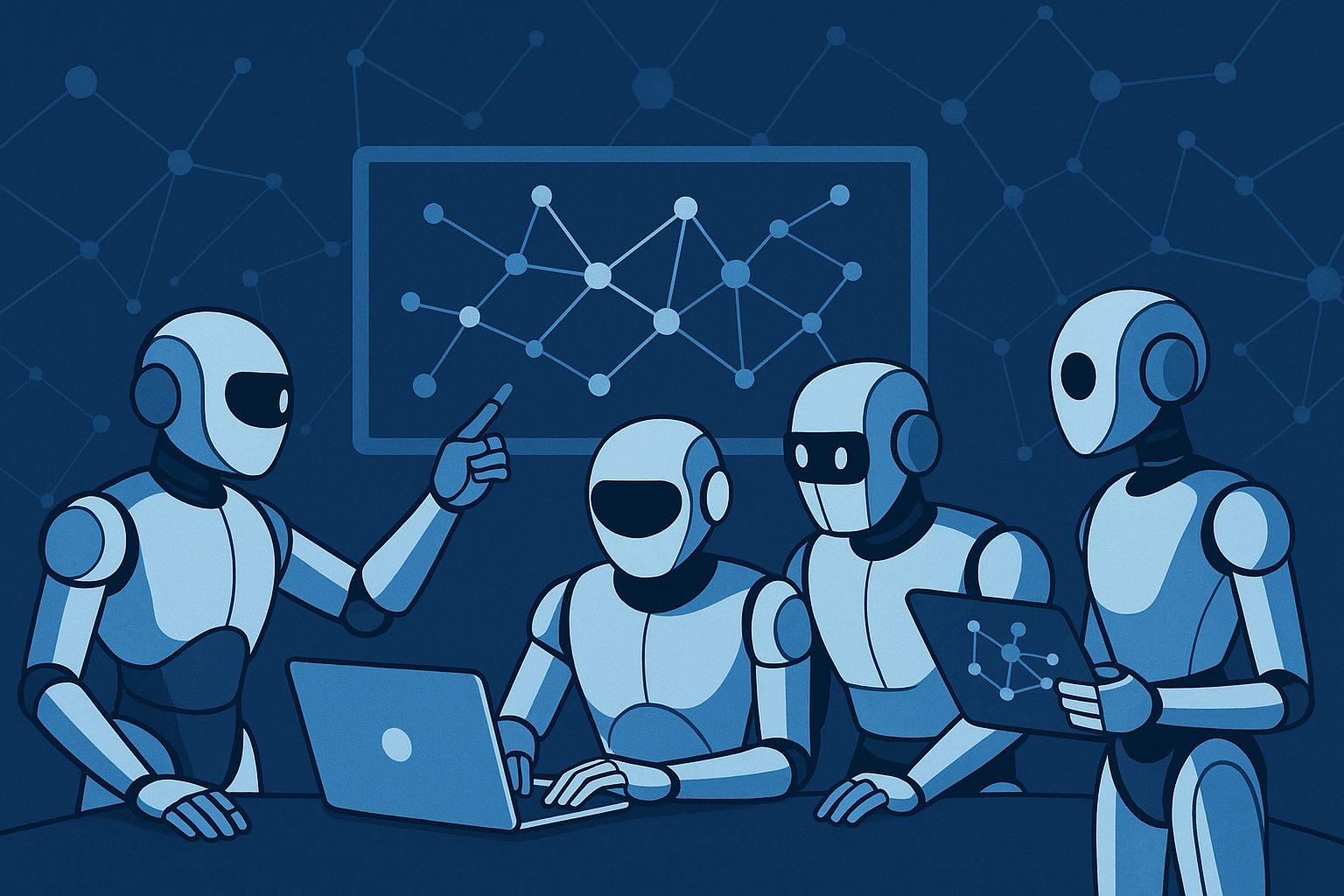
Multi-agent collaboration refers to a system where multiple autonomous agents interact within a shared environment to achieve individual or collective goals. Each AI agent operates semi-independently, perceiving data, reasoning based on its objectives, and taking actions. Then, the agents collaborate to share knowledge, coordinate tasks, and reach optimal outcomes through communication and negotiation.
Unlike traditional AI systems that depend on centralized decision-making, multi-agent systems (MAS) rely on distributed intelligence. This decentralization makes them highly adaptive, scalable, and resilient, especially in complex decision-making scenarios involving incomplete information or conflicting objectives.
Core Components of a Multi-Agent System
A multi-agent system (MAS) typically includes several interlinked components that allow intelligent cooperation:
1. Autonomous Agents
Each agent has its goals, perception mechanisms, and decision models. Agents can be rule-based, learning-based, or hybrid.
2. Communication Protocol
Agents use structured protocols (e.g., FIPA-ACL, JSON messaging, or graph-based knowledge exchange) for inter-agent communication, ensuring that messages are understood and interpreted consistently.
3. Coordination Mechanism
This defines how agents plan and divide tasks—using auction-based, contract-net, or coalition-formation models.
4. Decision-Making Engine
The intelligence core where machine learning, reinforcement learning, or game-theory models drive decisions.
5. Shared Knowledge Base
A repository of global context, domain knowledge, and learning history that supports reasoning and collaboration.
These components form a distributed intelligence ecosystem that allows agents to cooperate, compete, and co-create solutions especially in domains where human decision-making is limited by scale, time, or complexity.
The Power of Collaboration in Complex Decision-Making
In traditional decision systems, a single agent or algorithm attempts to solve a problem using available data. However, as the complexity of decisions increases, centralized approaches become inefficient, especially in dynamic and multi-stakeholder environments.
Multi-agent collaboration offers a new paradigm by distributing tasks among multiple intelligent entities that can:
- Perceive different aspects of the environment.
- Share partial knowledge and collectively form a holistic understanding.
- Negotiate and reconcile conflicts to arrive at balanced solutions.
- Adapt dynamically as new data arrives.
For example, in disaster management, multiple agents (drones, sensors, and command systems) can collaborate to assess real-time damage, identify safe zones, and allocate resources efficiently. No single agent has the complete picture, but together they enable data-driven situational awareness and faster decision-making.
Key Techniques Driving Multi-Agent Collaboration
Modern multi-agent systems leverage advanced AI and optimization techniques to enhance coordination and decision efficiency. Here are some of the most impactful ones:
1. Reinforcement Learning (RL) and Multi-Agent RL (MARL)
In multi-agent reinforcement learning, agents learn strategies not just from their environment but also from interactions with other agents. Techniques like Centralized Training with Decentralized Execution (CTDE) allow collective optimization without sacrificing autonomy.
2. Game Theory
Game-theoretic models define optimal strategies for agents operating under competition or cooperation. They help balance self-interest with collective welfare which is useful in supply chain negotiation, auction systems, and smart grids.
3. Knowledge Sharing and Ontologies
Agents use shared ontologies to interpret data consistently across domains. This semantic layer is crucial for interoperability and context-aware decision-making.
4. Federated Learning
In systems where data privacy is essential (e.g., healthcare or finance), federated learning enables agents to train models collaboratively without sharing raw data and preserving privacy while enhancing accuracy.
5. Consensus Algorithms
Protocols like Byzantine Fault Tolerance (BFT) or Proof-of-Stake (PoS) ensure agreement among agents in distributed systems such as blockchain networks or IoT ecosystems.
Real-World Applications of Multi-Agent Collaboration
Our commitment to excellence drives us to stay at the forefront of AI innovation. We believe that true digital transformation happens when we leverage advanced technologies like multi-agent systems collaboration to solve real-world business problems. Our team has partnered with organizations across diverse industries and decision environments to implement these intelligent architectures, empowering our clients to navigate complexity with confidence. The following examples showcase how we have applied these solutions:
1. Smart Cities and Infrastructure
In a smart city, thousands of IoT devices, sensors, and service bots act as agents, monitoring traffic, energy use, and public safety. Collaborative decision-making ensures traffic lights adapt to congestion, waste systems optimize routes, and energy grids balance supply and demand in real time.
2. Finance and Investment
Trading bots powered by multi-agent AI collaborate to assess risks, predict market trends, and adjust portfolios dynamically. This reduces human bias and enhances algorithmic decision accuracy in volatile markets.
3. Healthcare
Agents in medical decision support systems analyze patient data, imaging results, and genetic information collectively to suggest accurate diagnoses or personalized treatment plans.
4. Supply Chain and Logistics
In supply chain networks, agents representing manufacturers, warehouses, and transporters negotiate delivery schedules and pricing autonomously, minimizing cost while maintaining efficiency.
5. Autonomous Vehicles
In self-driving car ecosystems, each vehicle acts as an agent that communicates with others to avoid collisions, optimize routes, and maintain safe distances, demonstrating real-time cooperative intelligence.
6. Defense and Security
Multi-agent collaboration is also crucial in swarm robotics, where fleets of drones coordinate surveillance, reconnaissance, and rescue operations.
Multi-Agent Decision-Making Models
Complex decision-making relies on structured models that guide how agents interact. Some of the most widely used include:
1. Hierarchical Decision Models
Higher-level agents coordinate or supervise groups of lower-level agents, ensuring structured delegation and control, similar to human organizational hierarchies.
2. Market-Based Models
Agents use bidding and pricing mechanisms to allocate resources efficiently, reflecting real-world market dynamics.
3. Coalition Formation
Agents form temporary alliances to achieve shared objectives which is useful in collaborative robotics or project-based AI workflows.
4. Voting and Consensus Models
Agents participate in distributed voting to achieve collective agreement, often used in blockchain governance or distributed sensor networks.
Advantages of Multi-Agent Collaboration
Through our partnerships, we have personally witnessed how leveraging multi-agent collaboration systems translates directly into significant strategic benefits, driving profound client success. Here are several of the strategic benefits we’ve seen:
- Scalability – Adding new agents enhances system capacity without re-architecting the core.
- Resilience – Failure of one agent doesn’t compromise the whole system.
- Flexibility – Agents adapt dynamically to environmental changes.
- Parallelism – Multiple agents can process and act simultaneously.
- Improved Accuracy – Shared perspectives lead to more data-driven insights.
- Autonomous Optimization – Systems self-adjust without human intervention.
These advantages make MAS a foundation for next-generation decision ecosystems, where AI agents, humans, and data systems co-evolve toward collective intelligence.
Challenges in Multi-Agent Collaboration
While the advantages of this shift are clear, achieving success requires strategically addressing the underlying complexity. That is where our unwavering commitment is essential, guiding our clients to navigate and overcome these operational hurdles.
Here are some of the challenges multi-agent decision-making systems pose:
1. Communication Overhead
As the number of agents grows, message passing can become costly in bandwidth and computation.
2. Conflict Resolution
Balancing competing agent objectives requires sophisticated negotiation and reward mechanisms.
3. Trust and Security
Agents must verify each other’s intentions and data authenticity, especially in decentralized or adversarial environments.
4. Scalability of Learning
Coordinating training among hundreds or thousands of agents in multi-agent reinforcement learning demands significant computational resources.
5. Ethical and Governance Issues
As agents make autonomous decisions, accountability, bias, and transparency become critical considerations.
Ensuring the success of your multi-agent implementation requires more than technical skill; it demands a strategic partnership dedicated to overcoming complexity and delivering meaningful change.
The Future of Multi-Agent Collaboration
Multi-agent collaboration is only going to continue to evolve. The future of multi-agent collaboration lies in the convergence of Artificial General Intelligence (AGI), cloud computing, and edge intelligence. Emerging trends include:
- AI Agent Societies – Autonomous ecosystems where agents self-organize, negotiate contracts, and even govern themselves using blockchain-based governance frameworks.
- Human-AI Hybrid Decision Systems – Integration of human expertise with AI-driven reasoning for transparent and ethical decision outcomes.
- Collaborative Simulation Environments – Digital twins and simulation spaces enabling multi-agent systems to test scenarios before real-world deployment.
- Decentralized Autonomous Organizations (DAOs) – Using multi-agent collaboration models for collective business governance without centralized control.
As AI matures, multi-agent systems will underpin how enterprises, governments, and societies manage decisions at global scale—from climate change modeling to financial regulation to healthcare coordination.
Closing Thoughts
Multi-agent collaboration for complex decision-making represents a monumental leap in how we approach intelligence, autonomy, and coordination. Instead of a single monolithic AI making isolated decisions, the future belongs to ecosystems of intelligent agents—each specialized, autonomous, and collaborative.
By integrating reinforcement learning, game theory, knowledge graphs, and distributed communication, these systems can handle uncertainty, balance competing interests, and continuously learn from interactions. The result is a world where decisions are faster, fairer, and smarter—shaped not by isolated algorithms, but by collective intelligence in motion.
As industries adopt this paradigm, multi-agent collaboration will redefine the very fabric of AI-driven enterprise automation, strategic governance, and societal innovation.
Driving Meaningful Change: Your Strategic Next Step
We opened this conversation by noting that, according to Gartner, by 2027, half of all business decisions will be augmented or automated by AI agents. This shift demands more than just adopting new technology; it requires a strategic partnership to successfully integrate this into your core operations.
The congruentX difference is our unwavering commitment to client success. As a premier Microsoft solutions partner, we leverage our deep expertise in Microsoft’s Cloud, data, and AI to custom-build multi-agent systems that deliver quantifiable, meaningful change for your business. We are your forward-thinking partner dedicated to achieving your operational excellence.
We invite you to take the next step toward leveraging this powerful paradigm.
- Connect with a congruentX Partner: Start building your roadmap for multi-agent implementation and achieve operational excellence: Contact Us
- Explore Our Insights: View past webinars or register for an upcoming event to deepen your knowledge on AI and digital transformation: Events & Webinars
Frequently Asked Questions (FAQs)
1. What is a multi-agent system (MAS) in AI?
A multi-agent system is a network of autonomous agents that interact and collaborate to solve problems. Each agent can make decisions independently but also communicates with others to achieve shared or complementary goals.
2. How does multi-agent collaboration improve complex decision-making?
Multi-agent collaboration enhances decision-making by distributing tasks, sharing knowledge, and combining diverse perspectives. This reduces bias, increases efficiency, and allows systems to adapt dynamically to changing environments.
3. What industries use multi-agent systems today?
Multi-agent AI is widely used in finance, healthcare, transportation, supply chain management, smart cities, and defense—any field where autonomous coordination and rapid decision-making are crucial.
4. What are the main challenges in multi-agent collaboration?
Key challenges include communication overhead, trust and data security, conflict resolution, and scalability of learning. Managing these requires advanced algorithms, efficient protocols, and ethical frameworks.
Ready to strategically navigate these challenges and ensure operational excellence? We invite you to join our AI-Fueled Copilot Envisioning Lab to begin designing your implementation roadmap today.
5. What’s the future of multi-agent collaboration in AI?
The future involves AI agent societies, hybrid human-AI decision systems, and decentralized governance through blockchain and DAOs. As technologies evolve, multi-agent collaboration will drive innovation in every domain—from smart automation to strategic policymaking.