Insights
Evolution of AI Agents in Enterprise Automation – A New Era of Intelligent Workflows
If you’re frustrated by automation that breaks at the slightest change or chatbots that offer simplistic replies instead of real solutions, you are not alone. These brittle, static tools represent a broken promise. They fall short of empowering your team and delivering the meaningful change your business deserves.
But in the last decade, enterprises have undergone a transformative digital shift that solves these frustrations. Companies are moving to streamlined automation ecosystems powered by artificial intelligence. What we are witnessing today is the rise of AI Agents—autonomous, intelligent, decision-making systems that understand context, interact with humans, learn continuously, and execute business operations end-to-end.
Businesses are no longer satisfied with static automation scripts or simplistic chatbots. They expect solutions that think, adapt, troubleshoot, and collaborate. This is exactly where AI Agents are changing the game.
This blog explores the evolution of AI Agents in enterprise automation, the phases of growth, real-world applications, and how organizations are leveraging them for competitive advantage.
What Are AI Agents?
AI Agents are autonomous software entities capable of perceiving their environment, analyzing data, taking action, and learning from outcomes—without constant human intervention. They combine multiple technologies such as Machine Learning, Natural Language Processing, Cognitive Reasoning, and Generative AI to perform tasks intelligently and independently.
Unlike basic rule-driven scripts, AI Agents adapt and improve based on real-time feedback and evolving business scenarios.
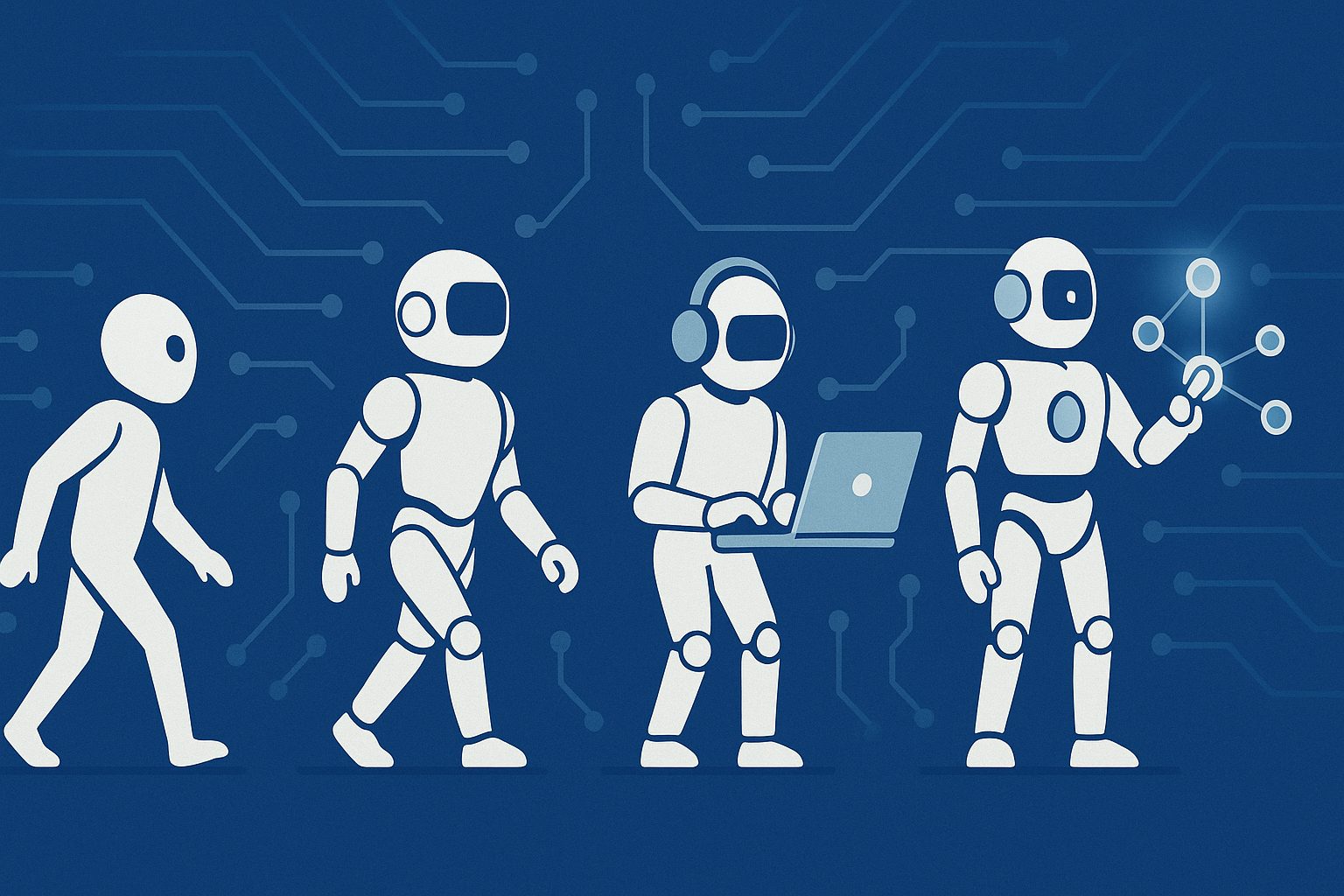
The Phases of Evolution: How We Reached Today’s Intelligent Agents
The shift to autonomous AI agents represents a pivotal moment in business technology. However, this revolution wasn’t a sudden event; it’s the culmination of a decades-long evolution. Each phase solved critical challenges while simultaneously paving the way for the next leap, moving us from rigid, fragile scripts to the truly intelligent, forward-thinking systems that now drive meaningful change.
Phase 1: Rules-Based Automation
Around the early 2000s, organizations used:
- Macros
- Workflow triggers
- Basic decision trees
These systems reduced manual effort but lacked flexibility. If conditions changed, workflows broke.
Phase 2: Robotic Process Automation (RPA)
Between 2010–2017, RPA emerged, popularized by tools like UiPath, BluePrism, and Automation Anywhere. RPA robots mimicked human actions:
- Clicking buttons
- Copying data
- Moving files
Limitation: RPA lacked understanding. If screen layouts changed or exceptions occurred, bots failed.
Phase 3: Cognitive Automation
Businesses integrated NLP, ML, and OCR to remove rigid rule dependencies:
- Recognizing invoices
- Understanding sentiment
- Extracting documents intelligently
This added intelligence, but still required human governance.
Phase 4: Generative AI & Autonomous AI Agents (Present)
Today’s AI Agents:
- Understand context
- Make decisions
- Communicate naturally
- Collaborate with humans
- Self-optimize over time
Platforms like OpenAI GPT-5, Anthropic Claude, Google Gemini, and custom multi-agent orchestration frameworks are driving this revolution.
Why Are AI Agents Transforming Enterprises?
The market’s widespread adoption of AI Agents is driven by a clear, strategic imperative: to solve fundamental operational challenges and unlock new levels of business value. These systems are the key to moving beyond incremental improvements, empowering organizations to achieve true operational excellence.
| Core Need | Solution Offered by AI Agents |
| Reduce Operational Cost | Agents automate repetitive, high-volume work |
| Need Faster Decisions | Agents analyze large datasets instantly |
| Improve Customer Experience | Agents provide real-time, personalized service |
| Optimize Business Workflows | Agents orchestrate multi-step processes end-to-end |
| Reduce Human Dependency | Agents work 24/7, continuously improving |
AI Agents aren’t just tools—they are digital workforce companions.
Types of AI Agents Used in Enterprises
To effectively leverage AI for digital transformation, it’s crucial to understand the distinct roles these agents play across the enterprise.
1. Task Execution Agents
Perform repetitive tasks such as:
- Data entry
- Spreadsheet updates
- Record synchronization
2. Knowledge Worker Agents
These agents:
- Search databases
- Generate insights
- Prepare summaries and reports
Used in:
- Finance reconciliation
- Research
- Legal document evaluations
3. Customer Support Agents
Empowered with NLP, they:
- Respond to customer queries
- Handle complaints
- Manage tickets and escalations
4. Developer & DevOps Agents
Perform:
- Code reviews
- Deployment workflows
- Incident triaging
Example: GitHub Copilot X + AI Ops agents.
5. Autonomous Workflow Orchestration Agents
These are the most advanced:
- They collaborate with other agents
- Break down tasks
- Assign responsibilities
- Validate outcomes
From automating simple tasks to orchestrating complex, end-to-end workflows, these agents represent a new digital workforce. Our commitment is to partner with you to integrate these capabilities, driving client success and delivering on our ROI promise.
Real-World Use Cases of AI Agents in Enterprise Automation
The true power of AI Agents is realized when they are applied to solve specific, high-stakes business problems. Our partnership model extends deep into the industries we serve. We see firsthand how organizations are leveraging this technology to empower their teams, innovate their services, and drive new levels of success.
Banking & Financial Services
- KYC document verification
- Fraud detection alerts
- Customer risk scoring
Healthcare
- Patient data analysis
- Appointment scheduling bots
- Intelligent diagnosis support
Retail & E-commerce
- Inventory forecasting
- Personalized product recommendations
- AI-driven customer support chat
Manufacturing
- Smart maintenance prediction
- Quality inspection automation via AI vision
- Supply chain optimization
IT & Cloud Operations
- Real-time server monitoring
- Automated incident resolution
- Predictive scaling
The Power of Multi-Agent Collaboration
Strategically integrating AI isn’t just about individual agent intelligence; it’s about their ability to collaborate. Real-world business processes are interconnected, multi-step operations that require coordination, validation, and specialized skills. To achieve efficiency gains in your operations, your digital workforce must mirror this reality, operating as a sophisticated, coordinated team rather than a collection of isolated tools.
This is where Multi-Agent Systems come in. They allow:
- One agent to validate input
- Another agent to analyze or compute
- Another agent to execute
- Supervisor agents to ensure quality & safety
This collaborative model is the cornerstone of building resilient, adaptive, and scalable automation. It creates self-managing, self-healing operational ecosystems. We partner with our clients to design and implement these multi-agent systems, leveraging the Microsoft Cloud to transform complex operational challenges into a strategic advantage and drive meaningful change.
The Role of AEO (AI Experience Optimization)
However, building this intelligent, collaborative workforce is only half the equation; we must also empower them to interact seamlessly and effectively with their human counterparts. AEO ensures that AI systems:
- Understand user intent
- Generate meaningful responses
- Learn from interactions
- Deliver smoother conversational experiences
AEO focuses on:
- Personalization
- Emotional context detection
- Continuous feedback adaptation
Enterprises are adopting AEO-first strategies for AI-powered support and workflow systems.
The Role of GEO (Google Expertise Optimization)
While AEO ensures a seamless internal experience, the full value of AI is only realized when that knowledge is discoverable and trusted externally. To leverage this technology for meaningful change, we must also ensure the content it produces is recognized as authoritative, empowering your organization to lead the conversation in your industry.
GEO ensures systems:
- Provide structured, accurate, search-friendly information
- Use semantic understanding
- Align with Google’s Helpful Content & EEAT frameworks
This ensures that AI-generated knowledge:
- Improves discoverability
- Enhances content relevance
- Drives higher organic engagement
Challenges in Adopting AI Agents
In our experience partnering with clients on their AI journey, we’ve identified key challenges in AI agent adoption, all of which can be effectively mitigated with a forward-thinking strategy like we’ve described in the table below:
| Challenge | Mitigation Strategy |
| Data Privacy & Security | Implement encryption, RBAC, audit logs |
| Model Bias or Inaccuracy | Continuous training + human governance |
| Workforce Resistance | Skill up employees + communicate benefits |
| Cost of AI Infrastructure | Use hybrid cloud or consumption-based pricing |
Future of AI Agents: What’s Next?
AI is entering the most exciting phase, where it moves from a simple tool to a core collaborative partner. This shift is the dawn of a new era, and over the next 3–5 years, we expects AI Agents will:
- Integrate deeper into Enterprise ERPs, CRMs, and SOC operations
- Gain emotional and situational awareness
- Become collaborative co-workers, not just tools
- Learn autonomously using self-supervised learning
We will see the rise of Self-Driving Enterprises. Make sure to choose the right partner to help you navigate this journey, leveraging technology to pave the way on this new frontier.
Empowering Your Future: A Partnership in Operational Excellence
We began this discussion by addressing a common frustration: the brittle, simplistic automation that so often breaks and fails to deliver real value. The evolution of AI Agents marks a pivotal shift from static workflows to intelligent, adaptive, and autonomous business ecosystems. Companies that embrace this transformation today will gain:
- Lower operational cost
- Faster decision cycles
- Improved customer satisfaction
- Stronger competitive positioning
But technology alone does not guarantee meaningful change. Achieving success requires a partnership built on a shared vision and deep expertise. At congruentX, our philosophy is simple: we don’t just implement technology; we build long-term relationships.
Our unwavering commitment is to your client success. We partner with you to navigate the complexities of AI, leveraging the full power of the Microsoft Cloud to design and deploy solutions that are not just intelligent, but also secure, scalable, and aligned directly with your strategic goals.
This journey is one of continuous innovation. If you are ready to move beyond frustrating automation and empower your business with a true AI partnership, we invite you to start the conversation.
To learn more about our approach and explore how we can drive meaningful change together, contact our team of experts today.
We also encourage you to view our past webinars or register for upcoming events to stay ahead of the digital transformation curve.
Frequently Asked Questions (FAQ)
1. What are AI Agents in enterprise automation?
AI Agents are intelligent software systems capable of understanding context, processing data, making decisions, and executing tasks without continuous human input. They combine Machine Learning, NLP, and Generative AI to deliver adaptive automation within enterprise workflows.
2. How are AI Agents different from traditional RPA bots?
Traditional RPA bots follow predefined rules and break when processes change. AI Agents, however, learn, adapt, and reason, which means they can handle exceptions, analyze patterns, and continuously improve performance over time.
3. Which industries benefit most from AI Agents?
Industries with high-volume workflows and complex decision-making benefit significantly. These include:
- Banking & Finance
- Healthcare
- Retail & E-commerce
- Manufacturing
- IT & Cloud Operations
4. Can AI Agents work with my existing ERP or CRM systems?
Yes. Modern AI Agents integrate easily with platforms like SAP, Salesforce, Dynamics 365, ServiceNow, and custom enterprise systems using APIs and workflow connectors. They enhance capabilities without requiring full system replacements.
To explore exactly how we can empower your organization by connecting AI to your specific systems, we invite you to register for our AI-Fueled Copilot Envisioning Lab.
5. How do AI Agents impact employee roles?
Rather than replacing employees, AI Agents automate repetitive tasks and free teams to focus on strategic, analytical, and creative work. The shift leads to upskilling, increased productivity, and more meaningful job roles.
6. Are AI Agents secure for handling sensitive enterprise data?
Yes — when implemented with proper:
- Access control
- Encryption
- Audit logging
- Compliance frameworks (ISO, SOC, GDPR)
Security depends on proper configuration and governance.
7. What are the main challenges in adopting AI Agents?
Common challenges include:
- Data quality issues
- Integration complexity
- Workforce change management
- Initial training time
These can be mitigated with phased adoption and human-in-the-loop oversight. Partnering with a seasoned expert will give you the front-end strategy to address these challenges head-on. Contact us to learn how we can help you on your adoption journey.
8. How can organizations start adopting AI Agents?
The best approach is Start Small, Scale Fast:
- Identify a repeatable workflow (ex: customer ticket triage).
- Deploy one or two AI Agents to automate parts of the workflow.
- Measure success (time saved, response accuracy).
- Scale across departments based on results.